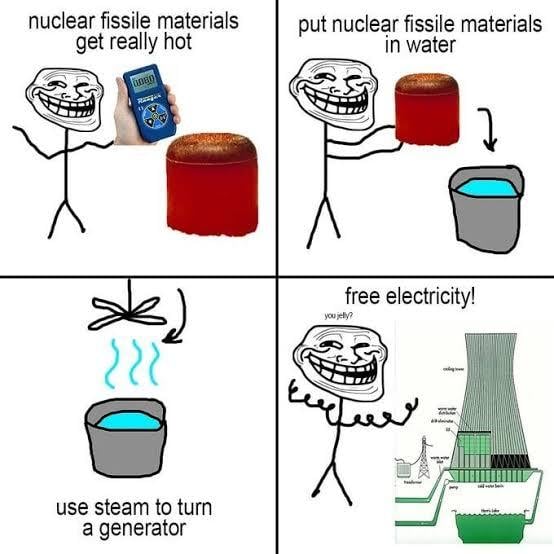

I’ve always found it slightly funny that nuclear power is technically just a fancy steam engine.
Almost all power source that generate electricity are fancy steam engines.
Wait, it’s all steam engines?
🔫 👩🚀🔫👩🚀 always has been
Hydro, wind, solar, and wave/tide energy capture are not.
The crazy part is photovoltaics are the only power source that doesn’t spin something to make electricity. Truly an outlier.
There’s one more outlier though which is Electrochemical cell, like galvanic element or voltaic pile
It was used around 1800 as a major electricity source, but I guess it quickly became uneconomical in 1866 or sth when the dynamo was invented.
Edit: wait yes, it actually says this in the second paragraph of the linked article:
The entire 19th-century electrical industry was powered by batteries related to Volta’s (e.g. the Daniell cell and Grove cell) until the advent of the dynamo (the electrical generator) in the 1870s.
Great call! Completely forgot about batteries and potato power sources!
Not entirely true, there is the thermoelectric generator too. Though it’s not very practical
Which requires them to output DC rather than AC, so they require inverters to change it to AC. It’s handier for battery storage though.
deleted by creator
Hydro is the most fancy steam engine since it waits for the water to recondense to make power.
Condensed steam.
Wait so does that make wind power more or less fancy than hydro?
Air is a fluid, it’s hydrodynamics all the way down.
Everything is a fluid. Sand is a fluid. Sand and water? Only sometimes.
Edit: this was not on topic, I just got mad at my old physics teacher for a second and channeled 16 year old me, sorry
It’s cool. I get why it’s easy to see the universe as various fluids. We are

I swear Nuclear Reactors were designed by a chemist with a grudge against a physicist and engineer.
Run low on water, stop reaction. Fission products keep getting hot even though reaction stopped. Not enough water to cool them off. Shit.
That’s why you have a closed water system and multiple failsaves.
Unless you want to cyka your last blyat.
What do I need to roll to pass the failsaves?
Roll yourself up in a blanket of lead and concrete
thankfully modern ones like molten salt reactors have passive safety, where they stop the reaction if overheating occurs.
edit: My mistake, there’s no active commercial molten salt reactors.
But nuclear power is very safe nowadays because of the multiple fail-safes, which some can still be passive like emergency cooling.
I much rather get electricity from magic rocks than destroying rain forest in developing countries drilling oil, gas or mining coal.
The biggest risk in nuclear is environmental disasters like in Fukushima’s case, which is the last significant nuclear incident in past 13 yearsAnd are those modern molten salt reactors in the room with us now?
2 MW. Fantastic. And only 8 years until it reaches continuous operation. How long will it be before that is anywhere near utility scale?
You can’t stop decay heat. It’s just molton salt reactors can operate at much higher temperatures and if it loses active cooling passive cooling with just air and infrared radiation while the salt passively circulates could be enough.
Isn’t molten salt just energy storage? Heat up salt when you have excess of energy, take heat out when you need it. The worst disaster there is just the container melting.
No, there are molten salt thermal batteries, but they aren’t the same as molten salt nuclear reactor. In a nuclear reactor the fissile material is dissolved in the salt for some reason, and the molten salt acts as a moderator or something. Apparently its safe because if the reactor power fails, the salt ‘freezes’ which prevents fission from occurring. Seems like complex extra steps to me but what do I know.
“Can’t have a meltdown when you’ve already melted the fuel” is pretty much the whole idea there.
MSRs have negative temperature reactivity coefficient and outlet temps around 700C at atm pressure. PWR is at measly 300C and 150 Bar.
If all control is lost, the salt expands as it heats up pushing the expanded volume out from the reactor core. The fission stops once the fuel is leaves the core region where the moderator is. Reverse is also true: you pull heat off from the loop, so the fuel-salt becomes denser, increasing reactivity. MSRs can naturally “follow” the load, if done right.
Ah yes, the passive safety of the molten salt spontaneously catching on fire when in contact with air and can’t be put out with water.
deleted by creator
Turn water back on suddenly and realize what happens when water touches an object many times warmer than it’s boiling point.
Just throw some sand and boron on it, she’ll be right mate.
Same applies to geothermal.
lava is really hot
use lava to boil water
use steam to turn a generator
free electricity!
Chat is this legit gameplay or an exploit?
Trolls and exploiters at it again. If god intended for us to make nuclear energy then he would’ve made it appear in nature. Stupid scientists making stuff from gods creation.
deleted by creator
Well but they’re not around anymore because the uranium inside them is all consumed by now, right?
Uranium is still there, it’s just sub-critical mass so the reaction isn’t happening. Uranium 235 (which would have powered the reaction) has a half life of ~700 million years. So there’s still probably a good bit of it there - the reaction is thought to have stopped about 1.7 billion years ago.
that makes sense, yeah
The Sun
that’s fusion, not fission
He said nuclear not specifically fission
ok
Exactly
Is just trolling.
Until you run out of that fissile material when you could just be using renewable energy…