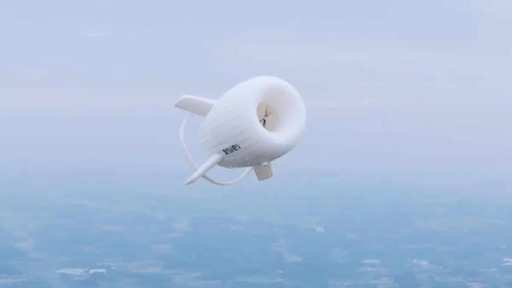
The S1500 floating turbine’s operating altitude is 4,921 feet above ground level, where wind speed moves about three times faster than at the surface. The advantage of this altitude (also referred to as vertical slice) can result in a power output up to 27 times higher than a conventional ground-based wind turbine of similar capacity.
The capacity to generate one megawatt of electrical power (MW) with the S1500 system is comparable in size to what small wind power turbines normally generate (a conventional 328-foot-tall wind turbine), while the footprint of the S1500 system is significantly smaller. This amazing power density shows the efficiency benefits of being able to access high altitude wind power resources by new and innovative airborne platforms.
How come the 131 foot altitude in the headline is never mentioned in the article? These turbine operates at 4,921 feet, a number that makes a lot more sense when you convert it to metric, 1.5 km. The article is littered with these odd imperial measurements that should have just been left as nice round metric numbers, or least re-rounded after conversion. 130 feet would have read better, but the original number was 40 m.
is it 131ft long? 🤔
Probably because the article was AI generated, if I had to guess.
It’s not that hard to comprehend both measurement systems. Both are valid and it’s up to the author to choose how they want to express their figures. You can send them a complaint if you want, but complaining about their measurements here isn’t going to change anything.
The wind at 32,000 ft is 200 times stronger than the wind at the surface?
Ummm… 10 knots * 200 = 2000 knots. I don’t think so lol.
A lot of strange numbers in this article that bring its accuracy into question.
No mention of the weight of a 1 and 1/2 km wire that is also suitable to anchor this thing in place. Or are they going to float batteries and bring them down to discharge?
Ummm… 10 knots * 200 = 2000 knots. I don’t think so lol.
First of all, kinetic energy scales with the square of an objects velocity.
Second, since we’re talking about a continuous stream of fluid instead of a single object, increasing the air speed not only increases the enegy per unit mass of air, but also the number of units of air per second that pass through the turbine. Which means that the amount of energy extracted scales by the cube of the wind speed.
https://kpenergy.in/blog/calculating-power-output-of-wind-turbines
So, more like going from 10 knots to 60.
Didn’t think about the possibility of a kinetic energy unit, thanks for the insight
I can’t be arsed to dig up the equation, but it may mean that the wind has 200 times more usable energy, which I think is a cube function of its speed. Wouldn’t be 2000 knots in that case
I’m thinking it’s about consistency. 10kts 10% of the time vs average 150kts 100% of the time (the math is a little off but we’re in hypothetical estimates already)
Maybe it means the kinetic energy of the wind, which I believe scales against its velocity-squared?
These are a massive liability every storm. You have to winch them down and get them into a blisteringly massive hangar that can hold them. Then get them set back up after. Every. Single. Storm.
Furthermore, you don’t save on land use, as you need the massive, expensive hangar for each right at their base.
Ground-based wind-turbines just feather their blades and lock their gearbox. Very simple.
Still better than coal
These are a massive liability every storm. You have to winch them down and get them into a blisteringly massive hangar that can hold them. Then get them set back up after. Every. Single. Storm.
Is anyone else getting aeon flux vibs?
Feeling like like Hindenburg up in here
Does it have batteries on board? How does it connect the power to the grid? O_o
If only there was a giant cable it was tethered to that could also carry electricity.
USB-C
Through a HV cable run to the ground, along with the cable to anchor it.
- Operational altitude: 4,921 feet
So precise - Weight: Under 2,204 pounds
Um… so 2,203 pounds?
- Operational altitude: 4,921 feet
This is an extremely promising innovation, and company plans on bigger designs already. But the total cost has to include an automated roof opening shelter for storms, that can open and close in medium winds before the high winds come. This makes the ground footprint higher than traditional turbines, even if agriculture can be done when there is no storm and roof is open. Perhaps 4 thethering strong cables could permit it to survive a cat 1 hurricane when hugging ground without a roof, but it is more weight to lift normally.
Lot’s of birds will be shredded
Have data to prove that? Because existing wind turbines hardly kill any birds. That’s oil lobby shit leaking through.
You know, I was skeptical that birds even got up that high.
Turns out this thing is actually far too low.

Incidentally, also why the other wind turbine bird death stories are largely horseshit.
Those studies gave a wide range for the number of birds that die in wind turbine collisions each year: from 140,000 up to 679,000. The numbers are likely to be higher today, because many more wind farms have been built in the past decade.
Those numbers are not insignificant, but they represent a tiny fraction of the birds killed annually in other ways, like flying into buildings or caught by prowling house cats, which past studies have estimated kill up to 988 million and 4 billion birds each year, respectively. Other studies have shown that many more birds—between 12 and 64 million each year—are killed in the U.S. by power lines, which connect wind and other types of energy facilities to people who use the electricity.
I wonder if the way they tested it to get those higher numbers was something like finding a field where birds were roosting with windmills present, then fire off some massive fireworks at night and assume any bird that died did so because of the windmills.
Assuming they didn’t just pull the numbers out of their ass and actually designed a bad faith experiment that could inflate bird deaths.
doesn’t this use elevations compared to sea level? while the elevation of this turbine is compared to local ground level