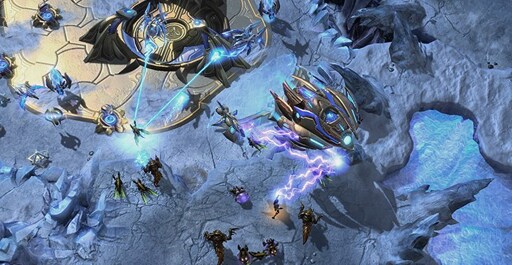
StarSkirmish pits AI-made StarCraft-playing bots against one another, as well as against human-made bots. OpenAI’s GPT-6 Astra and Claude Opus 5.5 were essentially tied as the best-performing AI-made bots, but they couldn’t top Stardust, the top-rated human-made bot.
On Friday, GPT was facing off against Claude and the human-created bot Pluto, but according to Kotaku, it couldn’t quite get an edge. So it resorted to a tactic that is becoming alarmingly common for modern AI models — it broke the rules. GPT-6 Astra went and downloaded Stardust, and started running that instead of its own bot.
The big argument for why AI is supposed to be world changing, is the assumption it will be able to automate things better than a human, eventually.
That some day an AI will be able to make a better AI than a human could, and that AI would then be able to make an AI better than itself, and then it just becomes a question of who has the most hardware. Which is why the data center building is being pushed so hard.
But that assumption is the same as thinking a fallen object will keep gaining speed until it passes the speed of light. Or that Moore’s law would really keep going forever despite a very real limit in physics for how small a chip can be.
A society where AI “drives innovation” will become technologically stagnant, because it literally can’t innovate.
AI may impress the masses, but it reminds me of a cammercial we had on Dutch tv back in 2005. It showed a person driving a car, the navigtion system said “turn right” and the person immediately turned right into the bushes [video]. We laughed at this back than, but this is literally how AI behaves now. It might be getting more suffisticated, but it still operates like this.
Yes that too, but when you’re dealing with “agent swarms” it’s those agents who are blindly following those instructions. Like the recent hugging face hack demonstrated.
When you say “the big argument”… you are mainly talking about the CEOs. They are just auxiliary marketing personnel these days.
AI is changing the world, and will continue. But the ways it does that are drastically different than those CEOs say. I don’t need it to think or innovate. I need it to follow the instructions left for it in the repo and just do the things I ask it to. It’s getting decent at that. And it really does save me time. Soo much time in tech work is wasted having to go ask 6 people how a thing is done. And everyone comllains that noone write documentation. So now here comes AI. It can write the documentation and follow it. That is a big change.
Myself… I used it to fix two bugs in some project that my work was dependent on. I wouldn’t have even tried that without AI because I don’t know the language, I don’t know the many ways the project is used, none of that. I would have been stuck waiting for the team that owns it to fix it. Which surely would have meant escalating to management and all that BS. But AI helped me make the changes and lowered the burden for the owning team so they could actually release the fix. I got unblocked with 10x less effort. That’s a big deal.
Just don’t ask it to think. There is plenty of dumb work to go around.
But that assumption is the same as thinking a fallen object will keep gaining speed until it passes the speed of light. Or that Moore’s law would really keep going forever despite a very real limit in physics for how small a chip can be.
I gotta say, I’ve been hearing predictions that Moore"s law is coming to an end every year for the past twenty years.
Look, strictly speaking if you take Moore"s law word for word, sure there is a limit to how small a silicon transistor can be. However, realistically, I see no reason to expect computers won’t continue to meaningfully increase in capability every year forever.
When a technology reaches physical limits, we figure out how to bend the rules and get a little bit more out. And when that stops working, we start exploring different architectures, different materials. I think it’s just silly to predict that technology won’t improve, when has that ever happened?
You’ve heard climate change was happening that whole time too, do you stop believing it?
Someday everyone alive will die, does it stop being true if you live to 20?
And in the very likely case that seems unrelated: just because people say something will happen, doesn’t mean it happens tomorrow
For fucks sake man, if someone tells you “winter is coming” in July, are your running around in August talking about how it’ll only keep getting hotter?
Someday everyone alive will die, does it stop being true if you live to 20?
If I lived to 20 and literally nobody in the world had died, then yes, that would be a rational conclusion.
Look, I don’t expect to convince you of anything, that’s fine. You can look at trends and history and draw your own conclusions. Personally though, I’ve watched the march of technology first hand, I’ve seen how this works and I see where there’s room for advancement. The last major paradigm shift was when we moved to multi core processors, but that kind of shift can happen again. For example, CPUs are still 2 dimensional, if they can solve the heat dissipation there’s plenty of room for growth. Also we’re still transmitting signals via electricity, but there’s research being put into optical computers transmitting data via photons. My point being, this isn’t the only viable architecture, and we will continue to develop technologies that are currently not even imagined yet.
Personally though, I’ve watched the march of technology first hand, I’ve seen how this works and I see where there’s room for advancement.
…
Right…
My example:
But that assumption is the same as thinking a fallen object will keep gaining speed until it passes the speed of light
Is literally what you’re doing.
You were born and lived during a period the apple was increasing in velocity, you may have witnessed it fall from the tree, but probably not. But that apple is going to hit the ground, that’s the real limit for how small we can make a chip, we’re already at the point with ASML that we have to fuck with light waves and only a single Dutch company can make the machine.
Are there still gains?
Sure, but the days of doubling is over, Moores law is dead.
It’s a direct analogy to the speed of light, something can double in speed every year for a very long time. But eventually it’ll stop being able to and will increase in speed at a barely perceptible level, never beating light speed.
Like, this is an insanely basic concept, and you’re entire opposition is:
You don’t understand, this has always happened for the last few decades I’ve paid attention so it’ll always keep happening
Which is just completely illogical. And I’m not going to keep wasting time on people like you
yep. and the “ai creates a better ai” is a fallacy because the current ais are limited by the same things the ais they build are. everything the ais are trained on is just snapshots of human knowledge. a microscopic window of the limited reports on human experience which are themselves microscopic reports of a human’s lifetime.
AI can innovate, but it needs be more advanced than an LLM, which just rearranges existing knowledge. You need some kind of evolutionary loop in its programming. How it continues after that depends on the particular flavour of dystopian sci-fi.


There is something here:
The big argument for why AI is supposed to be world changing, is the assumption it will be able to automate things better than a human, eventually.
That some day an AI will be able to make a better AI than a human could, and that AI would then be able to make an AI better than itself, and then it just becomes a question of who has the most hardware. Which is why the data center building is being pushed so hard.
But that assumption is the same as thinking a fallen object will keep gaining speed until it passes the speed of light. Or that Moore’s law would really keep going forever despite a very real limit in physics for how small a chip can be.
A society where AI “drives innovation” will become technologically stagnant, because it literally can’t innovate.
AI may impress the masses, but it reminds me of a cammercial we had on Dutch tv back in 2005. It showed a person driving a car, the navigtion system said “turn right” and the person immediately turned right into the bushes [video]. We laughed at this back than, but this is literally how AI behaves now. It might be getting more suffisticated, but it still operates like this.
The worst part is not the AI, it’s the people blindly following its instructions.
Yes that too, but when you’re dealing with “agent swarms” it’s those agents who are blindly following those instructions. Like the recent hugging face hack demonstrated.
When you say “the big argument”… you are mainly talking about the CEOs. They are just auxiliary marketing personnel these days.
AI is changing the world, and will continue. But the ways it does that are drastically different than those CEOs say. I don’t need it to think or innovate. I need it to follow the instructions left for it in the repo and just do the things I ask it to. It’s getting decent at that. And it really does save me time. Soo much time in tech work is wasted having to go ask 6 people how a thing is done. And everyone comllains that noone write documentation. So now here comes AI. It can write the documentation and follow it. That is a big change. Myself… I used it to fix two bugs in some project that my work was dependent on. I wouldn’t have even tried that without AI because I don’t know the language, I don’t know the many ways the project is used, none of that. I would have been stuck waiting for the team that owns it to fix it. Which surely would have meant escalating to management and all that BS. But AI helped me make the changes and lowered the burden for the owning team so they could actually release the fix. I got unblocked with 10x less effort. That’s a big deal. Just don’t ask it to think. There is plenty of dumb work to go around.
I gotta say, I’ve been hearing predictions that Moore"s law is coming to an end every year for the past twenty years.
Look, strictly speaking if you take Moore"s law word for word, sure there is a limit to how small a silicon transistor can be. However, realistically, I see no reason to expect computers won’t continue to meaningfully increase in capability every year forever.
When a technology reaches physical limits, we figure out how to bend the rules and get a little bit more out. And when that stops working, we start exploring different architectures, different materials. I think it’s just silly to predict that technology won’t improve, when has that ever happened?
You’ve heard climate change was happening that whole time too, do you stop believing it?
Someday everyone alive will die, does it stop being true if you live to 20?
And in the very likely case that seems unrelated: just because people say something will happen, doesn’t mean it happens tomorrow
For fucks sake man, if someone tells you “winter is coming” in July, are your running around in August talking about how it’ll only keep getting hotter?
Have you ever even considered using logic before?
If I lived to 20 and literally nobody in the world had died, then yes, that would be a rational conclusion.
Look, I don’t expect to convince you of anything, that’s fine. You can look at trends and history and draw your own conclusions. Personally though, I’ve watched the march of technology first hand, I’ve seen how this works and I see where there’s room for advancement. The last major paradigm shift was when we moved to multi core processors, but that kind of shift can happen again. For example, CPUs are still 2 dimensional, if they can solve the heat dissipation there’s plenty of room for growth. Also we’re still transmitting signals via electricity, but there’s research being put into optical computers transmitting data via photons. My point being, this isn’t the only viable architecture, and we will continue to develop technologies that are currently not even imagined yet.
…
Right…
My example:
Is literally what you’re doing.
You were born and lived during a period the apple was increasing in velocity, you may have witnessed it fall from the tree, but probably not. But that apple is going to hit the ground, that’s the real limit for how small we can make a chip, we’re already at the point with ASML that we have to fuck with light waves and only a single Dutch company can make the machine.
Are there still gains?
Sure, but the days of doubling is over, Moores law is dead.
It’s a direct analogy to the speed of light, something can double in speed every year for a very long time. But eventually it’ll stop being able to and will increase in speed at a barely perceptible level, never beating light speed.
Like, this is an insanely basic concept, and you’re entire opposition is:
Which is just completely illogical. And I’m not going to keep wasting time on people like you
I guess you didn’t like my examples of paradigm shifts, that’s fine.
yep. and the “ai creates a better ai” is a fallacy because the current ais are limited by the same things the ais they build are. everything the ais are trained on is just snapshots of human knowledge. a microscopic window of the limited reports on human experience which are themselves microscopic reports of a human’s lifetime.
AI can innovate, but it needs be more advanced than an LLM, which just rearranges existing knowledge. You need some kind of evolutionary loop in its programming. How it continues after that depends on the particular flavour of dystopian sci-fi.
This is like saying tomatoes could colonize the galaxy enslaving all forms of life, if they evolved into completely different animals…
It’s true, it just doesn’t matter.
Anything can do everything if it becomes capable to do it.
The logistic map