

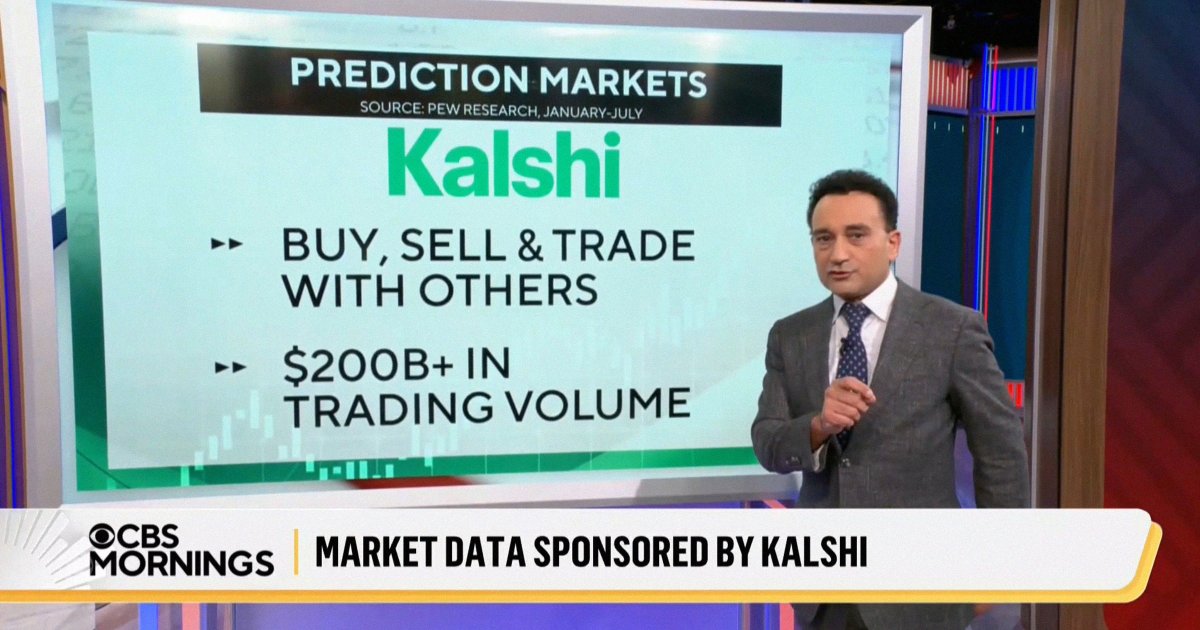
CBS is not a news organization.
“Prediction markets” is sure one hell of a marketing spin.
It’s gambling. Nothing more, nothing less.
Doin’ it for the clicks, not the truth.
CBS is not a news agency.
Calling a betting market »journalism« is quite the innovation: why investigate power, verify facts, or protect sources when you can just put odds on reality and call it data? CBS partnering with Kalshi feels less like the future of news and more like turning election night into a casino with correspondents.
Journalists embracing the prediction markets was called an “Op-Ed” back before the internet. Nothing new here just lots of different words arranged in a different way to tell you the same old thing.
Fine, prediction markets are gambling. They are better gambling propositions than traditional oddsmaker books which have higher margins/house take baked into them.
Big political outcomes is a helpful prediction market service, even/because insiders can cheat by betting on the outcome. Midterm outcomes, or (4% chance) of $5000 dividend cheque by March 31 2007 are specific probabilities that reveal pure BS.
Some horrible contracts are whether a speech will include some word, or outcomes that have already been predetermined (Oscars) with insiders who know 100% betting vs the clueless. Other terrible contracts include US-Iran ceasefire status. Too ambiguous, and resolution process is prone to corruption.
Still, these markets are more useful predictors than polls, because experts are analyzing with money instead of bias.
They’re better predictors of what people think will happen.
That can correlate with what does happen, but they’re not the same thing. As much as Kalshi et al’s marketing would like to suggest otherwise. They’re not oracles or crystal balls.
They’re better predictors of what people think will happen.
They’re better predictors of what people that use them think will happen
That is some serious spin on a garbage gambling system that is easily manipulated. Like sports betting the goal is to try and get both sides to bet as evenly as possible and then take your cut off the top.
These markets are useful to take money from rubes and all your spin on their usefulness amounts to an endorsement that there is some value if you look hard enough. Hint: there isn’t.
Like sports betting the goal is to try and get both sides to bet as evenly as possible and then take your cut off the top.
False. The house just takes a percentage of all bets (usually 0.5%). The price (from 0 to $1) is what fully balances buyers/sellers. The house has no risk of loss. You can say that futures markets or options are gambling with large majority of participants eventually losing everything they put up, but that doesn’t mean that futures prices do not have predictive value.
You obviously don’t understand what you are commenting on, and there is no valid reason to call what I said, endorsement spin.
The goal is engagement. If you don’t understand drawing as many players on both sides of the bet is the most profitable for them then you must not understand how this really works.
You must be operating under some profound misconceptions of what modern bookies for sports betting do.
bookies put up their own money on the other side. adjust odds to try to even up the sides of a bet. Prediction markets are like a casino rake on a poker game. The casino is not gambling its own money.
That was how they used to do things, and I am sure there may be some people who still operate like this.
Modern bookies use juice which amounts to small fees to make profit, balance the books by encouraging betting on both sides, hedge their bets by passing on risk to larger bookies and/or betting sites, and of course ban players if they are winning too much.
The deregulated nature of this form of gambling results in a lot of corruption and predictive betting is even more problematic.
As much as y’all don’t want this to be accurate, sadly, it kind of is. Non-US betting markets in 2016, 2020, and 2024 all correctly called the US presidential election better than Five Thirty Eight or polls or any other formerly reliable method.
At which point were they more accurate? 5 minutes before the final count was counted? An hour? A day? Without this number is like a percentage with unknown reference.
They were better at 5 minute/hour before networks called results, for sure. 2016 had HRC/dems for congress 80% odds of winning both day before, and before polls closed. 2020 has Biden winning during that time, but when results were being announced state by state, Trump jumped to a 75% chance of winning. Here, the networks were right to say “but Philadelphia hasn’t counted yet” type of hedges to “fake early leads” by Trump who was yelling to stop counting. 2024 was predicted well the whole time.
