

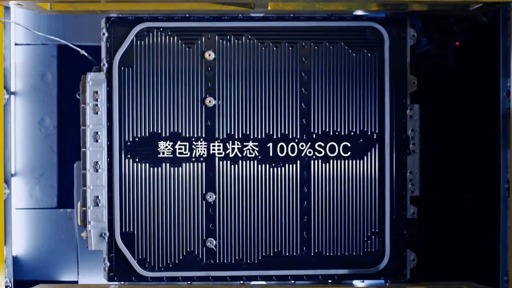
The second-generation Blade battery can charge from 10-70% in just about five minutes and from 10-97% in under 10 minutes. More impressively, the company showcased the battery charging flawlessly from 20-97% at -22°F (-30°C) in just about 12 minutes, only around three minutes slower than it charges in normal temperatures.
…
The EV was plugged in at 9% state of charge with 93 kilometers of range (57 miles). In 9 minutes and 51 seconds, it charged up to 97% with the range prediction in their gauge cluster displaying 1,008 kilometers (626 miles). This is likely calibrated for the China Light-Duty Test Cycle (CLTC), which tends to be more optimistic than the Environmental Protection Agency (EPA) test cycle in the U.S.
Still, these charging speeds are way faster than the 20-40 minute charging stops on the latest EVs in the U.S. The new BYD EVs can basically recharge in nearly the same time it takes to refill a gas car. Even the new 1,500 kilowatt (1.5 megawatt) Flash charging stations are arranged like a traditional gas station for cars to quickly drive in and drive out.
There is no incentive for US companies to improve their products when they are protected from market forces by import restrictions.
What US companies? Only three remain (GM, Ford, Tesla) and they make up a fraction of sales here in the US. The Chinese government is dumping truckloads of money into subsidies and development, control nearly all rare earth minerals, and don’t shy away from environmental disasters and human rights abuses which is why they’re the only nation on the planet that’s able to develop this rapidly and sell their vehicles for way less than anyone else on the planet. Once they control everything you can kiss those low prices and rapid development goodbye, but you’ll still buy from them because nobody else will be left standing.
If all that is true, then the US should subsidize US ev’s to the point where they are price competitive and open the market to competition where US manufacturers can market against the environmental and human right issues with their Chinese competitors. That would put competitive pressure on Chinese manufacturers to clean up their supply chains and consumers worldwide would benefit.
Who’s going to build them though? GM and Ford have almost completely eliminated producing vehicles that aren’t SUVs and trucks because nobody was buying them and Tesla is floundering with a Nazi leading the company. Most people are buying German, Japanese, or South Korean cars and they aren’t able to compete against China either for all the aforementioned reasons.
The fact that nobody else in the entire world can match what they’re doing despite hundreds and hundreds of collective years building and selling cars should clue you in to what’s happening. It’s like saying a city should subsidize their local general store to compete against Walmart and wondering why nobody is doing just that.
Maybe stop selling garbage?
Don’t forget Dodge, speaking of garbage…
They did stop selling garbage which is precisely why they’ve almost completely left the passengar car market in favor of trucks and SUVs, which sell like hot cakes.
Dodge/Chrysler/Jeep is owned by Stellantis which is based in the Netherlands. They haven’t been an American company for quite some time now.
They’re fully in thrall to market forces. Those forces simply dictate that they lobby for protected markets. It’s far cheaper to buy off a lobbyist than to build a cutting edge battery factory