

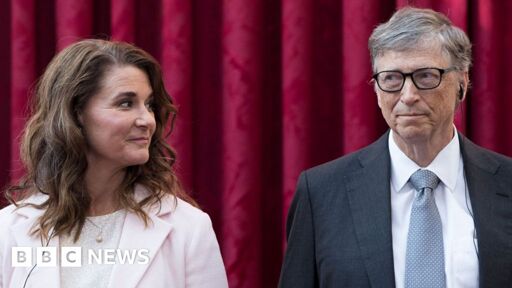
Billionaire philanthropist Melinda French Gates has said her ex-husband, Microsoft co-founder Bill Gates, being named in new files relating to the late sex offender Jeffrey Epstein dredged up “painful times in my marriage”.
She told an NPR podcast she feels “unbelievable sadness” about the Epstein allegations and that the people named in the records, including her former husband, need to answer to it.
“I am so happy to be away from all the muck,” she said. The couple divorced in 2021 after 27 years of marriage.
Records released by the US justice department include an allegation by Epstein that Bill Gates caught a sexually transmitted disease. He has called the claim “absolutely absurd”.
Yes, but he donated a fraction of his fortune to a set of charities chosen to maximize their PR value! That totally absolves him!
Not even purely for PR value. One of his foundation’s causes is providing free medicines to third-world countries – to stave off their saying “fuck patents” and producing the drugs for themselves, thereby helping to erode intellectual property rights.
Fun fact this has always confused me because I would think the best way to maximize PR value would be to just set up a metric fucktonne of charities basically everywhere with a wide breadth of functions. The whole hyper specific charity thing just comes across as weird at best intentionally manipulative at worst, which I guess is the point but it should be harder to tell at first glance y’know?
As I understand Bill Gates is a member of the effective altruism movement, which is a movement that argues that we should support the most effective charities that are actually proven to do good by measurable metrics, not just assumed to do good. The idea is to study different interventions and see how effective and how expensive they are (e.g. let’s say we want to pay for textbooks for kids in Sierra Leone to help them complete school. Sure, seems like a good idea. But does that actually result in a greater percentage of students completing school? or is the reason they don’t finish school mainly because they can’t get enough to eat and they’re suffering from tuberculosis, in which case the money would be better spent on tuberculosis treatment and food or just giving money directly to the families?). As a baseline, it compares how effective it is to just give money directly to the world’s poorest people. And it only supports charities that are more effective than that, per dollar. This ends up supporting a few niche charities because if charity A proves they can save a life for $100 and charity B proves they can save a life for $200, you may as well dump as much money into charity A as they can handle, and only give money to charity B if charity A runs out of capacity/ability to save lives at that price.