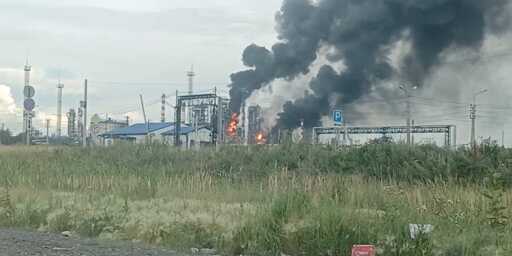
Ukraine struck Russia’s largest oil refinery, located in the city of Omsk, on Monday, marking what its forces say was its furthest-ever drone attack in the war.
The Omsk facility, which processes about 21 million tons of oil a year, is in Western Siberia and about 1,700 miles from Ukrainian territory — roughly the distance between Los Angeles and Houston.
And the greatest and second largest army of the world, didn’t even notice a few foreign drones traveling 1700 miles across their land! I wonder who’s gonna fall out of a window for this.
Put in Put out
Im a little out of the loop, why are they suddenly able to do this now? What changed in their capabilities?
They’ve been specifically targeting Russian Air defenses for awhile now forcing them to spread what little they do have even more. Since NATO have been pussies about providing them long range precision munitions they’ve had to spend time to develop their own cruise missiles like the Neptune and Flamingo the latter of which has entered regular production and has a range of 3000km.
Wanna know too
The article says that they’re jet launched.
TIL Siberia is way bigger than I expected. I knew it was big, but it looks like it’s more than half of Russian landmass. It can’t all be the climate I’m picturing, right? Like it borders Kazakhstan, so I figure at least part of it has to have hot summers
Though is that comparison corrected for the projection? Texas is farther south than Siberia and with the usual projection used, you can only compare the sizes of things at the same latitude. It’s the same thing that makes Greenland look as big as Africa when it’s closer to the size of South Africa.
Though is that comparison corrected for the projection?
Yes. Check it out here: https://truesize.net/en/
lol, you got me, that’s what twigged it for me- I figured Siberia would start further east of Ukraine than Texas is of California
Siberia is actually 3/4ths of Russia’s landmass. The northern parts are taiga, which are giant uninterrupted forests. The shores of the Arctic Ocean are mostly tundra. In the southern parts the taiga gives way to steppes.
In the northern parts the climate has warm but quite short summers and long cold winters. In the southern part, where most of the population lives, they have the same climate as southern Canada/New England just less humid. The Western parts are also covered by warm winds that originate from the Middle East and hence have higher temperatures than their more Eastern areas. For reference in Novosibirsk, which is the largest city the average yearly summer temperatures reach 25 degrees Celsius but temperatures can also spike to as high as 38 degrees.
So yeah Siberia is not all some barren tundra as most people imagine.
“Do you know how many time zones they have?” “Uh, yessir. Uh, four … uh, no sir. I never really studied that up.” “Eleven.” “Eleven. It’s not even funny.” “Eleven.” “Eleven. That’s, that’s ridiculous.” “Eleven.”