
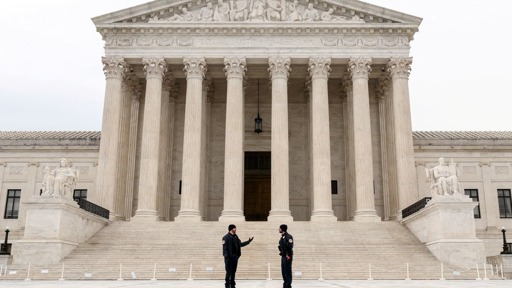
The U.S. Supreme Court declined on Monday to take up the issue of whether art generated by artificial intelligence can be copyrighted under U.S. law, turning away a case involving a computer scientist from Missouri who was denied a copyright for a piece of visual art made by his AI system.
Plaintiff Stephen Thaler had appealed to the justices after lower courts upheld a U.S. Copyright Office decision that the AI-crafted visual art at issue in the case was ineligible for copyright protection because it did not have a human creator.
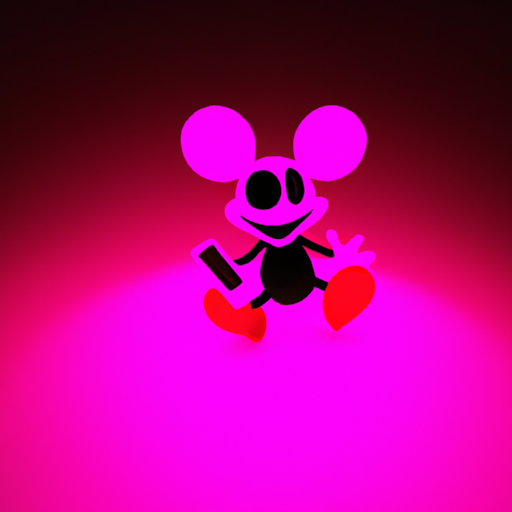
Thaler, of St. Charles, Missouri, applied for a federal copyright registration in 2018 covering “A Recent Entrance to Paradise,” visual art he said his AI technology “DABUS” created. The image shows train tracks entering a portal, surrounded by what appears to be green and purple plant imagery.
The Copyright Office rejected his application in 2022, finding that creative works must have human authors to be eligible to receive a copyright. U.S. President Donald Trump’s administration had urged the Supreme Court not to hear Thaler’s appeal.
Seems reasonable. This case is substantially similar to previous cases that were taken up by the supreme court - in particular a finding over whether a selfie generated by a monkey was copyrightable - and the lower court decisions are in line with the previous precedents set by the supreme court. So they’re effectively just saying “Our opinion hasn’t changed.”
If you want to call yourself an artist, do the work yourself, Stephen.
You limpdick, no talent ass clown.
My understanding is that he did do the work of creating the AI. This isn’t just someone using ChatGPT.
In this case, it’s not that he’s trying to claim copyright for himself based on coming up with a prompt. He’s spent years applying for patents and copyrights with the AI listed as the creator.
He can copyright his software then? That’s like saying that if I create a computer game where the computer also plays, I own the copyright to every single game played by the computer. It’s just dumb. They stole the artwork that it was trained on, so move along thief.
In other words, it’s not that he as the human operating the “AI” is trying to claim copyright in his own name, it’s that he’s trying to set a precedent where the “AI” can hold copyright in its own name.
He’s trying to pretend that his glorified pile of statistics is sentient, and get it legally recognized as such. 🤡
Exactly.
Most of the comments in this thread are accusing him of trying to take credit for the work of a machine that’s just imitating other work. It’s the FuckAI echo chamber and people who didn’t actually read the article.
In this case, it’s more like he’s claiming to have created a genuinely creative being that deserves rights previously reserved for humans (like copyrights and patents).
It’s a completely different (and IMO, much weirder) story than people are assuming.
ITT: people misunderstanding the issue being ruled on (or rather, not being ruled on by letting the lower court decision stand).
If he had applied for copyright over the image generated using “AI” as a tool, it (edit: probably2) would have been granted, with him listed as the human author. But that’s not what he wanted. He’s apparently Hell-bent on trying to get the work registered in the name of the “AI” system itself as the author, to so that he can claim that the government recognized the “AI” as a sentient being that can
own propertyhold a copyright1 on its own behalf.This is not the broad ruling against AI slop copyrightability that people think it is. It’s a ruling against “AI” personhood.
(1 Copyright isn’t a property right, BTW)
(2 He explicitly claimed he gave no creative contribution and that the work was created completely autonomously, and the court’s ruling included excluding that from being copyrightable. It is if he hadn’t done that – if he had claimed he had directed it via prompts or whatever – that I think they would have granted the copyright to him as the human author. It turns out that he changed his mind and did make that argument on appeal, but the court explicitly ignored and did not rule on it because it wasn’t raised in his initial complaint.)
How can you copyright something you didn’t make?
In the same way Disney owns the copyright of what their workers made.
Gonna be fun times in courts as anyone can claim something was generated by AI even if an artist claims they created it.
I wonder if this will end up limited to art or can be expanded to other copyrighted works.