

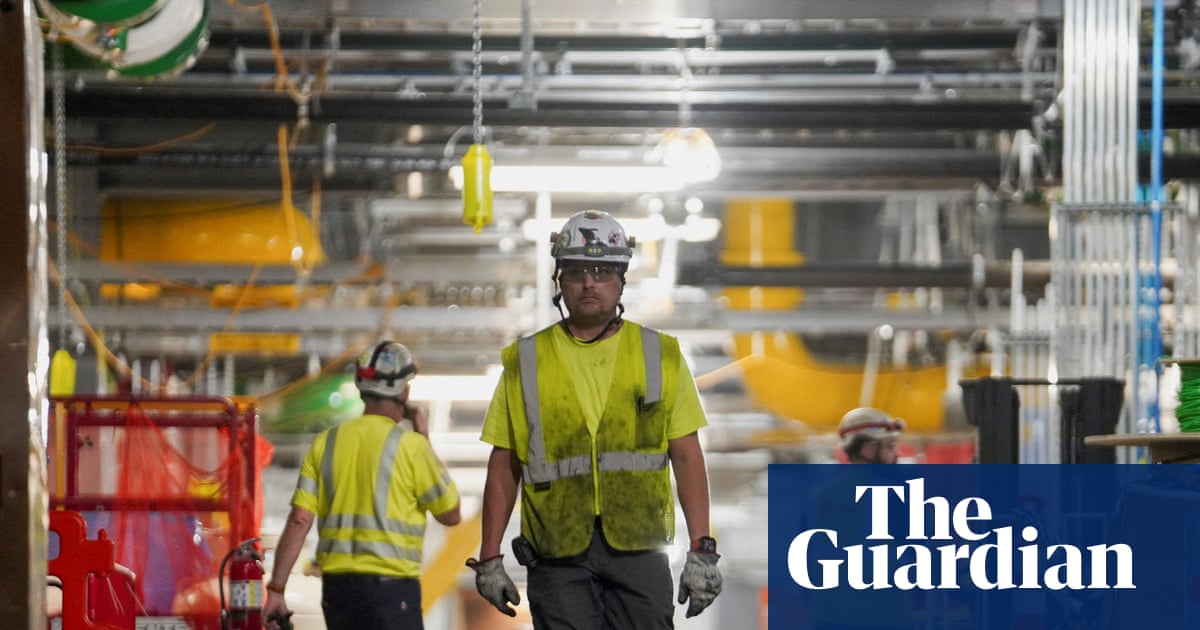
Microsoft and other US tech companies successfully lobbied the EU to hide the environmental toll of their datacentres, an investigation has found, with demands to block a database of green metrics from public view written almost word for word into EU rules.
The secrecy provision, which the European Commission added to its proposal almost verbatim after industry lobbying in 2024, hinders scrutiny of the pollution that individual datacentres emit. It leaves researchers with just national-level summaries of their energy footprints.
The rise of AI chatbots has spurred a boom in the construction of chip-filled warehouses with a hunger for power that is being met, in part, by burning fossil gas. Legal scholars warn the blanket confidentiality clause may fall foul of EU transparency rules and the Aarhus convention on public access to environmental information.
“In two decades, I cannot recall a comparable case,” said Prof Jerzy Jendrośka, who spent 19 years on the body overseeing the convention and teaches environmental law at the University of Opole in Poland. “This clearly seems not to be in line with the convention.”
The corruption needs to stop. Eat the rich.
Okay so we’ve all been saying this since when?
When?
When does it start?
Now?
How about now?
Now??
Now is good
I mean some people have started see Luigi, warehouse guy, guy who threw moltov at Sam Altmans house, guy shooting at politicians home for voting in favor of an AI datacenter in their town, and I am sure there are more that I am unaware of too.
Perhaps we shouldn’t send politicians burned by domestic corruption scandals to Brussels. 🤔
No one should fail upwards.
I keep reading about lobbying. I don’t fully understand how it works. Are there requirements for disclosure, approval and public transparency, or is this just something individual politicians or groups can do just like that?
It’s supposed to be a way (groups of) people can make their case to the legislative branch to inform them about their issues and propose ways to resolve them.
In reality it’s just legal corruption used by magacorporations to screw over the aforementioned people.
The reality of the situation is more or less clear, but it helps to understand how things are supposed to work. They make their case and then what? does the audience decide on its own? Otherwise it seems difficult to buy the entire… voting majority?
Not everything is voted on of course, some things are just decided by smaller committees.
And for things that are voted on they “buy” few vocal debaters who convince the rest with bad reasoning that sounds legit.
The part with the smaller committees sounds anti-democratic. The later is a different problem (politicians being misinformed/lazy is not specific to lobbying)
It’s the way the world works. Not every decision can go through a plenary session. Nothing would get done that way.
The latter is obviously not specific to lobbying, but it is the way they get their plans across. Not everyone in the parliament can be as well informed about every issue they vote on. If everyone had to read in to every detail of every single issue that they vote on, again nothing would get done.
So if we want to get things done we need to accept that the system isn’t flawless. That doesn’t mean we can’t curb lobbying though. We need to improve the regulations on that. But of course, it is strongly opposed by lobbyists who hold a lot of power.


